

Bridging the Analog and Digital Worlds
In the realm of electronics, the seamless transition between analog and digital signals is essential for countless applications. This is where analog-to-digital (A/D) and digital-to-analog (D/A) converters come into play. These crucial components bridge the gap between the continuous world of analog signals and the discrete realm of digital information. This article delves into the intricacies of A/D and D/A converters, exploring their fundamental principles, applications, and the technological advancements driving their evolution.
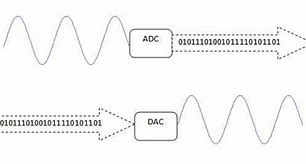
Understanding Analog and Digital Signals
Before diving into the world of converters, it’s essential to grasp the distinction between analog and digital signals.
Analog signals: These are continuous signals that vary smoothly over time, mirroring real-world phenomena like sound waves or temperature variations.
Digital signals These are discrete signals represented by a sequence of binary digits (0s and 1s). They are processed and transmitted efficiently by digital electronic systems.

The Role of A/D Converters
An analog-to-digital converter (ADC) transforms an analog signal into a digital representation. This process involves sampling the analog signal at regular intervals and quantizing the amplitude of each sample to a digital value. The accuracy of this conversion is determined by factors such as resolution (number of bits), sampling rate, and quantization error.
Key components of an ADC
Sample and hold circuit Captures the analog signal’s value at a specific instant.
Quantizer Converts the sampled value into a digital code.
Output register Stores the digital code for further processing.
Common types of ADCs
Successive approximation: Achieves high accuracy and speed.
Flash: Offers high-speed conversion but can be power-hungry.
Sigma-delta Provides high resolution but requires oversampling.
The Role of D/A Converters
A digital-to-analog converter (DAC) performs the reverse operation, converting a digital signal back into an analog form. It reconstructs the original analog signal based on the digital data. The quality of the reconstructed signal depends on the DAC’s resolution, linearity, and settling time.
Key components of a DAC
Digital-to-analog converter core Generates an analog output based on the digital input.
Output amplifier Buffers the analog output and provides the necessary current or voltage levels.
Common types of DACs
Weighted resistor: Simple but suffers from accuracy limitations.
R-2R ladder Offers better accuracy and linearity.
Current-steering Provides high speed and power efficiency.

Applications of A/D and D/A Converters
A/D and D/A converters find applications in a wide range of fields:
Audio and video systems
Converting analog audio and video signals into digital format for processing, storage, and transmission.
Data acquisition
Capturing physical phenomena like temperature, pressure, and acceleration for digital analysis.
Telecommunications
Modulating analog signals onto digital carriers for efficient transmission.
Medical equipment
Converting analog biosignals (ECG, EEG) into digital format for analysis and diagnosis.
Industrial control systems Monitoring and controlling industrial processes through digital interfaces.

Challenges and Future Trends
Despite their widespread use, A/D and D/A converters face challenges such as noise, distortion, and power consumption. Ongoing research and development are focused on improving converter performance, reducing power consumption, and increasing integration levels.
Future trends include
Higher sampling rates and resolutions
Enabling more accurate representation of complex signals.
Lower power consumption Extending battery life in portable devices.
Integration with other components
Combining A/D and D/A converters with other functions on a single chip.
Advanced signal processing algorithms
Enhancing the quality of converted signals.
A/D and D/A converters are indispensable components in the modern electronic world. Their ability to seamlessly bridge the analog and digital domains has enabled countless technological advancements. As technology continues to evolve, we can expect further innovations in converter design, leading to even more sophisticated and efficient systems.
[Insert relevant images and diagrams illustrating A/D and D/A converter principles and applications]
Would you like to focus on a specific application or technology related to A/D and D/A converters?
Faqs
What are A/D and D/A Converters?
A/D Converter (ADC): An electronic device that converts analog signals (like sound from a microphone or light from a camera) into digital signals (numbers) that can be processed by computers.
D/A Converter (DAC): Does the opposite of an ADC. It converts digital signals back into analog signals, often used to drive speakers or other analog devices.
How do A/D and D/A Converters work?
A/D Conversion: The analog signal is sampled at regular intervals, and each sample is assigned a digital value based on its amplitude.
D/A Conversion: The digital values are used to generate a continuous analog signal by creating a series of voltage levels that approximate the original analog signal.
Why are A/D and D/A Converters important?
They are essential components in modern electronics and communication systems, enabling the processing and transmission of analog information in a digital format.
They are used in a wide range of applications, including audio and video equipment, medical devices, industrial control systems, and more.
Common Challenges in A/D and D/A Conversion
Quantization Error: The difference between the analog input and the digital representation due to the limited number of bits used in the ADC.
Aliasing: The creation of spurious frequency components in the reconstructed analog signal due to undersampling.
Noise: Unwanted electrical signals that can degrade the performance of both ADCs and DACs.
How to choose the right A/D or D/A converter?
Consider the required resolution (number of bits), sampling rate, dynamic range, and other specifications based on the specific application.
Evaluate the performance metrics such as signal-to-noise ratio (SNR), total harmonic distortion (THD), and spurious-free dynamic range (SFDR).
Consider the cost, power consumption, and size of the converter.
Real-world applications of A/D and D/A converters
Audio: Digital audio recording, playback, and processing.
Video: Digital video cameras, displays, and editing.
Telecommunications: Digital modulation and demodulation of analog signals.
Medical imaging: Digital X-rays, MRI, and ultrasound.
Industrial control: Digital sensors and actuators.
Do you have any other questions about A/D or D/A converters?
To read more click here