
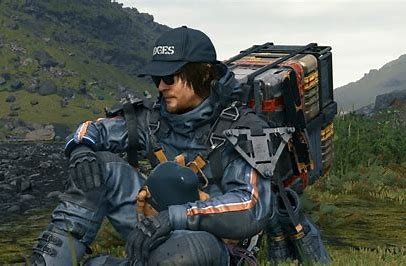
Death Stranding, the enigmatic brainchild of legendary game designer Hideo Kojima, is an action-adventure video game unlike any other. Released in 2019, it captivated players with its unique blend of post-apocalyptic world-building, intriguing narrative, and innovative delivery mechanics.

This article delves into the depths of Death Stranding, exploring its core elements, gameplay, critical reception, and lasting impact.
A World Divided: The Strands and the BTs
Death Stranding’s world is a desolate landscape forever altered by an event known as the Death Stranding. This cataclysmic event blurred the lines between the world of the living and the dead, creating a realm teeming with “Beached Things” (BTs) – grotesque, spectral creatures drawn to the living.
Strands, invisible tethers that connect all living beings, play a crucial role in the fragile state of this world.
Players take on the role of Sam Porter Bridges, a courier tasked with reconnecting isolated settlements scattered across the ruined United Cities of America (UCA). Sam’s mission is to rebuild a fractured nation by using the Chiral Network, a communication technology that utilizes Strands.
However, the journey is fraught with danger. BTs lurk in the spectral world, invisible to the naked eye, and pose a deadly threat to those who encounter them.
Delivering Hope, One Package at a Time: Exploring Gameplay
Death Stranding’s core gameplay loop revolves around making deliveries. Players navigate treacherous landscapes on foot or using various vehicles, managing cargo weight and balance while avoiding BTs and hostile human factions.
The game emphasizes careful planning, strategic pathfinding, and resource management to ensure successful deliveries.
Beyond deliveries, the world offers a unique online asynchronous multiplayer experience. Players leave behind structures like bridges and signs for others to utilize, fostering a sense of community even in a desolate world.
Similarly, players can encounter the footprints and remnants of other players’ journeys, adding a subtle layer of connection in this isolated setting.
A Cryptic Narrative: Unraveling the Story
Kojima is known for his layered narratives, and Death Stranding is no exception. The story unfolds through a combination of cutscenes, in-game dialogue, collectible data entries, and environmental details.
Themes of isolation, connection, and the fragility of life permeate the narrative, leaving players to piece together the bigger picture throughout the journey.
The game’s story tackles complex topics like the rise of technology, the impact of isolation, and the importance of human connection.
While some players found the narrative cryptic and slow-burning, others appreciated its depth and philosophical undertones.
Critical Reception and Lasting Impact
Death Stranding received a mixed critical reception. Some reviewers praised its innovative gameplay, unique atmosphere, and thought-provoking story. Others criticized its slow pacing, repetitive delivery mechanics, and convoluted narrative.
Despite the mixed reviews, Death Stranding developed a devoted fan base who appreciate its unconventional approach to open-world gameplay.
The game’s lasting impact lies in its originality. Death Stranding defied genre conventions, pushing the boundaries of interactive storytelling and gameplay mechanics.
Beyond the Deliveries: Exploring Additional Aspects
Here are some additional aspects that contribute to Death Stranding’s unique experience:

Art Style and Soundtrack:
The game boasts a striking visual design, with a blend of haunting beauty and desolate landscapes. The atmospheric soundtrack, composed by Ludvig Forssell in collaboration with artists like CHVRCHES and Major Lazer, further enhances the game’s unique mood.
Dooms and Preppers:
Players encounter a diverse cast of characters throughout the world, from reclusive “Preppers” offering valuable resources to “Dooms” – monstrous BTs that pose a significant threat.
Strand Mechanics:
The game utilizes unique Strand-based mechanics like “Timefall,” where rain accelerates the passage of time, and the “Hematic Grenade,” a weapon that can be used to repel or attack BTs.
Whether appreciated for its innovative gameplay, thought-provoking story, or simply for its unique atmosphere, Death Stranding leaves a lasting impression.
FAQs
Q: What is the basic premise of Death Stranding?
A: You play as Sam Porter Bridges, a courier tasked with reconnecting a fractured America after a catastrophic event called the Death Stranding. You deliver supplies and rebuild connections in a world overrun by ghostly beings (BTs) and strange phenomena.
Q: What is the “Death Stranding” event?
A: The game doesn’t explicitly define it, but it’s a cataclysm that blurred the lines between the living world and the realm of the dead. This allows BTs to cross over and pose a threat.
Q: Why is reconnecting America so important?
A: Reconnecting cities through a network called the Chiral Network weakens the hold of the BTs and potentially allows for humanity’s survival.
Q: What kind of game is Death Stranding?
A: It’s an open-world action game with strong elements of resource management and social connection (indirectly through players).
Q: Is it just a walking simulator?
A: While navigating the vast landscapes is a core gameplay loop, there are combat encounters, boss battles, and strategic delivery challenges to overcome.
Q: How do BTs work?
A: These spectral beings are invisible most of the time. You use special tools and your senses to detect them and avoid being dragged to the “Seam,” the world of the dead.
Q: What happens if a BT catches you?
A: You’ll face a voidout, a destructive event that creates a crater and potentially spawns even more dangerous BTs.
Q: Who are the main characters in Death Stranding?
A: You encounter a diverse cast including Amelie, a mysterious woman with connections to the afterlife; Deadman, a bridge between the living and the dead; and Higgs, a terrorist with a unique connection to BTs.
Q: What is the significance of the Bridges baby in Sam’s pod?
A: These special babies help Sam sense BTs. The exact biology and connection remain shrouded in mystery.
Q: Is there a deeper meaning to the story?
A: Yes, the game explores themes of connection, isolation, and the fragility of life. It’s open to interpretation, sparking discussions and theories among players.
Q: Is Death Stranding available on PC?
A: Yes, an enhanced version was released in 2020 after the initial PlayStation 4 release.
Q: Is there a sequel to Death Stranding?
A: Hideo Kojima, the game’s creator, has hinted at a potential sequel, but there is no official announcement yet.
Q: Is Death Stranding a horror game?
A: It has some suspenseful and creepy elements, but the core gameplay focuses more on exploration and delivery.
Q: Does Death Stranding have online features?
A: Yes, it has asynchronous multiplayer elements. Players leave structures and resources for others to find in their world, fostering a sense of community without direct interaction.
To read more click here