
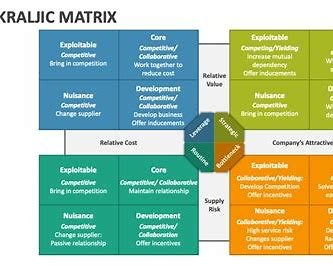
In the ever-evolving world of supply chain management, making informed decisions about procurement is crucial for any business.
Kraljic’s Matrix, developed by Peter Kraljic in the 1980s, remains a valuable tool for categorizing purchased items and strategizing effective procurement approaches.

This article delves into the core concepts of Kraljic’s Matrix, exploring its benefits, applications, and how it can empower businesses to optimize their purchasing strategies.
Understanding the Matrix: Supply Risk vs. Profit Impact
Supply Risk:
This assesses the difficulty and vulnerability associated with sourcing a particular item. Factors like limited suppliers, volatile pricing, and technological dependence contribute to higher supply risk.
Profit Impact:
This evaluates the item’s influence on a company’s profitability. Items crucial for production or with high margins have a significant profit impact.
By plotting purchased items on the matrix based on their supply risk and profit impact, businesses gain valuable insights into which items require the most strategic procurement focus.
The Four Quadrants of Kraljic’s Matrix
The matrix is divided into four quadrants, each representing a distinct category of purchased items and suggesting appropriate procurement strategies:
Strategic Items (High Supply Risk, High Profit Impact):
These are critical items with limited supplier options. Here, the focus is on building strong relationships with reliable suppliers, potentially through long-term contracts or joint ventures. Negotiating favorable terms, diversifying suppliers if possible, and securing alternative sourcing options become crucial.
Bottleneck Items (High Supply Risk, Low Profit Impact):
These items are essential for operations but don’t significantly impact profitability. Here, the aim is to secure reliable supply at a competitive cost. Strategies like volume discounts, second sourcing, and value engineering to find cost-effective alternatives might be considered.
Leverage Items (Low Supply Risk, High Profit Impact):
These are readily available items with a significant impact on profitability. Here, the focus is on cost reduction. Negotiating aggressively with multiple vendors, utilizing competitive bidding processes, and exploring substitute materials are potential strategies.
Non-Critical Items (Low Supply Risk, Low Profit Impact):
These are readily available, low-cost items with minimal impact on profitability. Here, streamlining procurement processes is key. Implementing automated ordering systems, utilizing online marketplaces, and focusing on cost-efficiency are potential approaches.
Benefits of Using Kraljic’s Matrix
Kraljic’s Matrix offers several advantages for businesses:
Improved Procurement Strategy:
By categorizing items based on their risk and impact, the matrix guides businesses in developing targeted procurement strategies for each category.
Reduced Costs:
Kraljic’s Matrix helps identify areas where cost savings can be maximized. This allows businesses to focus resources on negotiating better deals for high-impact items.
Enhanced Supply Risk Management:
Highlighting items with high supply risk prompts businesses to develop mitigation strategies, such as diversification or building stronger supplier relationships.
Data-driven Decision Making:
The matrix encourages a data-driven approach to procurement, moving away from intuition and towards a well-defined strategy based on clear categories.
Improved Communication:
Kraljic’s Matrix can be a valuable communication tool within an organization. It fosters a shared understanding of procurement priorities across different departments.
Beyond the Basics: Implementing Kraljic’s Matrix Effectively
While Kraljic’s Matrix is a valuable starting point, successful implementation requires further considerations:
Data Gathering and Analysis:
Accurately assessing supply risk and profit impact for each item is crucial. Data from various sources like historical purchasing records, market research, and supplier assessments is needed.
Dynamic Approach:
Supply chain dynamics can change rapidly. Businesses should periodically re-evaluate their Kraljic Matrix to ensure it reflects current market conditions and business needs.
Customization:
The matrix is a framework, not a rigid formula. Businesses can tailor it to their specific industry, size, and risk tolerance.
Collaboration:
Effective procurement requires collaboration across departments, including purchasing, finance, and engineering.

Conclusion: Kraljic’s Matrix – A Timeless Tool for Procurement Success
Despite its simplicity, Kraljic’s Matrix remains a powerful tool for businesses seeking to optimize their procurement strategies.
By categorizing purchased items based on supply risk and profit impact, businesses can make informed decisions, build stronger supplier relationships, and ultimately achieve greater cost efficiency and supply chain resilience.
In today’s complex and ever-changing business landscape, Kraljic’s Matrix offers a timeless framework for navigating the world of procurement and ensuring a strong foundation for long-term success.
FAQs
Q: How does the Kraljic Matrix help businesses?
It helps identify optimal procurement strategies for different types of purchases, optimizing costs and mitigating risks.
Q: How do companies approach Strategic Items?
Building strong relationships with reliable suppliers and negotiating long-term contracts is key.
Q: What about Leverage Items?
Here, companies leverage competition among suppliers to get the best price. Standardization and volume discounts are important.
Q: How can companies manage Non-Critical Items efficiently?
Focus on streamlining the procurement process and potentially using online marketplaces.
Q: What’s the strategy for Bottleneck Items?
Mitigating risk might involve dual sourcing or developing alternative suppliers to avoid disruptions.
Q: How often should companies revisit Kraljic’s Matrix?
It’s recommended to review the matrix regularly as market conditions, supplier relationships, and product needs may evolve.
Q: Are there limitations to Kraljic’s Matrix?
Yes, it doesn’t consider all factors like technology disruptions or ethical sourcing practices.
Q: How can companies integrate Kraljic’s Matrix with other strategies?
It can be combined with tools like ABC analysis for a more comprehensive procurement strategy.
Q: How does the Kraljic Matrix impact supplier relationships?
The strategy for each category requires different levels of collaboration and communication with suppliers.
Q: Can strong supplier relationships impact Kraljic’s Matrix categories?
Absolutely! Building trust with a supplier might move a Leverage Item towards Strategic if their reliability is crucial.
Q: How does technology influence Kraljic’s Matrix application?
Procurement software and data analytics can automate tasks and provide better insights for categorization.
Q: Can online marketplaces be relevant for Strategic Items?
While not always, some online platforms offer access to specialized suppliers for specific needs within the Strategic category.
Q: How can Kraljic’s Matrix be used to consider sustainability?
Companies can prioritize environmentally friendly suppliers or sustainable materials, potentially impacting categorization.
Q: Are there ethical considerations when using Kraljic’s Matrix?
Yes, companies should ensure ethical sourcing practices across all categories, not just focus on cost savings.
Q: Can you give an example of how a company might use Kraljic’s Matrix?
A car manufacturer might categorize windshields as Strategic (high risk, high importance) and negotiate closely with a reliable supplier.
Q: How might a small business benefit from Kraljic’s Matrix?
Even small businesses can use it to optimize office supply purchases (Non-Critical) and negotiate better deals with packaging suppliers (Leverage).
To read more click here