
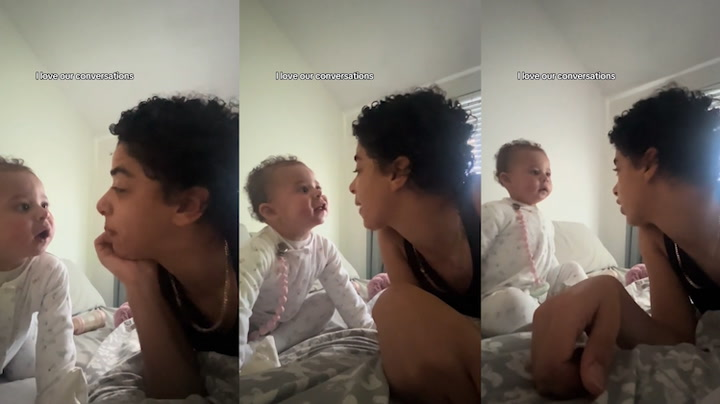
Baby babbling scouse accent- The internet was recently captivated by a heartwarming video of a baby seemingly speaking with a distinct Scouse accent, despite not uttering a single recognizable word. This phenomenon has sparked widespread curiosity and fascination, prompting questions about language acquisition and the intricacies of accent development.
The Viral Sensation
A TikTok video featuring a young baby engaging in a seemingly one-sided conversation with her aunt quickly garnered millions of views. The baby’s vocalisations, though unintelligible, carried the unmistakable cadence and intonation of the Scouse accent, the dialect predominantly spoken in Liverpool, England. The video’s popularity ignited a fervent online discussion about how a baby could possibly develop such a specific accent without possessing a vocabulary.
The Science Behind Baby Babble
To understand this linguistic marvel, it’s essential to delve into the science of language acquisition. Babies are born with an innate ability to learn any language, and they begin experimenting with sounds almost immediately after birth. This early stage, often referred to as babbling, is crucial for developing the neural pathways necessary for speech.
While babbling may initially seem random, it’s actually a complex process influenced by the language environment surrounding the baby. Babies are incredibly attuned to the sounds and rhythms of the language they hear most frequently, and they unconsciously begin to imitate these patterns. This is why babies raised in different linguistic environments develop distinct babbling styles.
In the case of the Scouse baby, consistent exposure to the Scouse accent has shaped her vocalizations, even before she can produce recognizable words. The baby’s brain is already mapping the melodic contours and rhythmic patterns of the dialect, which are then reflected in her babbling.
The Role of Prosody
Prosody, the melodic aspect of language, plays a pivotal role in accent development. It encompasses intonation, stress, rhythm, and pitch variation. Babies are highly sensitive to prosodic cues, and they quickly learn to associate specific patterns with different meanings.
The Scouse accent is characterized by its distinctive intonation and rhythmic patterns. By imitating these prosodic features, the baby is effectively laying the foundation for developing a fully-fledged Scouse accent once she begins to speak.
The Impact of Social Media
The viral video of the Scouse baby has not only entertained millions but also sparked important conversations about language, culture, and identity. The clip has highlighted the fascinating process of language acquisition and the power of social media to amplify and share captivating stories.
While the video may seem like a mere novelty, it offers a valuable glimpse into the complex world of language development. It reminds us of the incredible capacity of young minds to absorb and process information, and it underscores the importance of early language exposure in shaping a child’s linguistic identity.
Beyond the Cute Factor
The phenomenon of baby babbling with accents is not unique to the Scouse dialect. Similar observations have been made in various language communities around the world. These instances provide valuable insights into the early stages of language development and the interplay between nature and nurture in shaping linguistic abilities.
As research in this field continues to advance, we can expect to uncover even more fascinating details about how babies acquire language and develop accents. The study of baby babbling holds the potential to revolutionize our understanding of language learning and may lead to innovative approaches to language education and therapy.
In conclusion, the viral video of the Scouse baby has captured the hearts and minds of people worldwide. While the phenomenon may seem astonishing, it is rooted in well-established principles of language acquisition. By understanding the science behind baby babbling, we can gain a deeper appreciation for the remarkable linguistic abilities of our youngest members of society.
FAQs
The Viral Sensation
Q: What is the Scouse baby babbling phenomenon?
A: A video of a baby named Orla from Liverpool went viral in 2024, captivating millions with her ability to mimic a distinct Scouse accent while babbling.
Q: How old is Orla, the baby with the Scouse accent?
A: Orla was approximately 19 months old when her video went viral.
Q: Where can I watch the video of Orla babbling in a Scouse accent?
A: The original video was shared on TikTok by the account @iamcustardpot. It quickly gained massive popularity and has been shared widely on other platforms.
The Science Behind It
Q: Is it normal for babies to babble with an accent?
A: While it’s not uncommon for babies to mimic sounds around them, developing a full-fledged accent at such a young age is unusual. Orla’s case is considered a fascinating example of early language acquisition.
Q: How do babies learn accents?
A: Babies are incredibly perceptive listeners. They pick up on the speech patterns, intonation, and rhythm of the language they hear most frequently, which in Orla’s case is the Scouse accent.
Q: Will Orla retain the Scouse accent as she grows older?
A: It’s too early to say for sure. While children tend to maintain regional accents, language development is complex, and Orla’s accent may evolve over time.
Impact and Reactions
Q: What has been the reaction to Orla’s video?
A: The video has generated immense online buzz, with people sharing their amusement, amazement, and admiration for Orla’s linguistic abilities. It has also sparked discussions about language development and regional dialects.
Q: Has Orla’s video had any impact on Scouse culture?
A: While it’s difficult to measure the exact impact, Orla’s video has undoubtedly brought attention to the Scouse accent and Liverpool’s unique linguistic heritage.
Q: Are there other examples of babies babbling with accents?
A: While cases like Orla’s are relatively rare, there have been other instances of babies displaying early accent imitation. These examples further highlight the incredible capacity of young children to learn and adapt to language.
Baby Language Development
Q: What is the importance of babbling for babies?
A: Babbling is a crucial stage in language development. It helps babies experiment with sounds, strengthen their vocal cords, and prepare for speech.
Q: How can parents encourage language development in their babies?
A: Talking to your baby regularly, reading to them, and providing a stimulating language environment are essential for their language development.
Q: When do babies typically start saying their first words?
A: Most babies begin to say their first words around 12 months of age, but there is a wide range of normal development.
Conclusion
Orla’s ability to babble with a Scouse accent is a captivating example of the human brain’s incredible capacity for language acquisition. While her case is exceptional, it sheds light on the fascinating process of how babies learn to speak.
To Read More; click here